When AI chatbots first hit the web, most designers worried. I went and learned the tools.
The reflex across the creative industry was protective: keep your head down, hope it blows over, hope clients keep paying for the old workflow. I made the opposite bet. If the tools were going to reshape the work, I wanted to be early on the other side of that shift — fluent enough to use them, opinionated enough to lead other people through them, and grounded enough in original craft to know what AI is actually good for and what it isn't.
That bet has played out two ways. Personally, AI is now part of my daily practice — for ideation, prototyping, presentation building, planning, and measurement. Organizationally, it's become a core part of what I'm hired to lead: building training, identifying use cases, and rolling AI capability into the employee experience at Fortune 500 scale.
The risk to designers who skipped this shift is now visible. The ones who never built the underlying creative foundation — who only know how to arrange components in Figma — are getting transitioned into prompt writers and workflow specialists, or replaced outright. The ones who can direct AI from a place of original vision are getting more leverage, not less.
Lead the adoption, set the guardrails, keep the vision human.
My approach to AI works at three levels at once: my own daily practice, the teams I lead, and the enterprise programs I help shape. The connective tissue is the same across all three — get fluent in the tools, understand where they help and where they fail, and never let the model's output substitute for the original creative direction.
The work has spanned individual craft through enterprise transformation:
- Enterprise AI training & change management at Corteva Agriscience — built the organizational training program covering how to use generative AI tools, the risks and required mitigations, and a clear case for up-skilling global team members into the AI era rather than walling the technology off.
- HR transformation leadership at Kraft Heinz — part of the leadership team applying AI across the employee experience, including a personal assistant that lets team members access policies and knowledge base articles and complete tactical admin work, freeing them to focus on strategic priorities.
- Enterprise AI use case development at Kraft Heinz — helping the company identify and implement new applications across recruiting, frontline worker interactions, and business process automation.
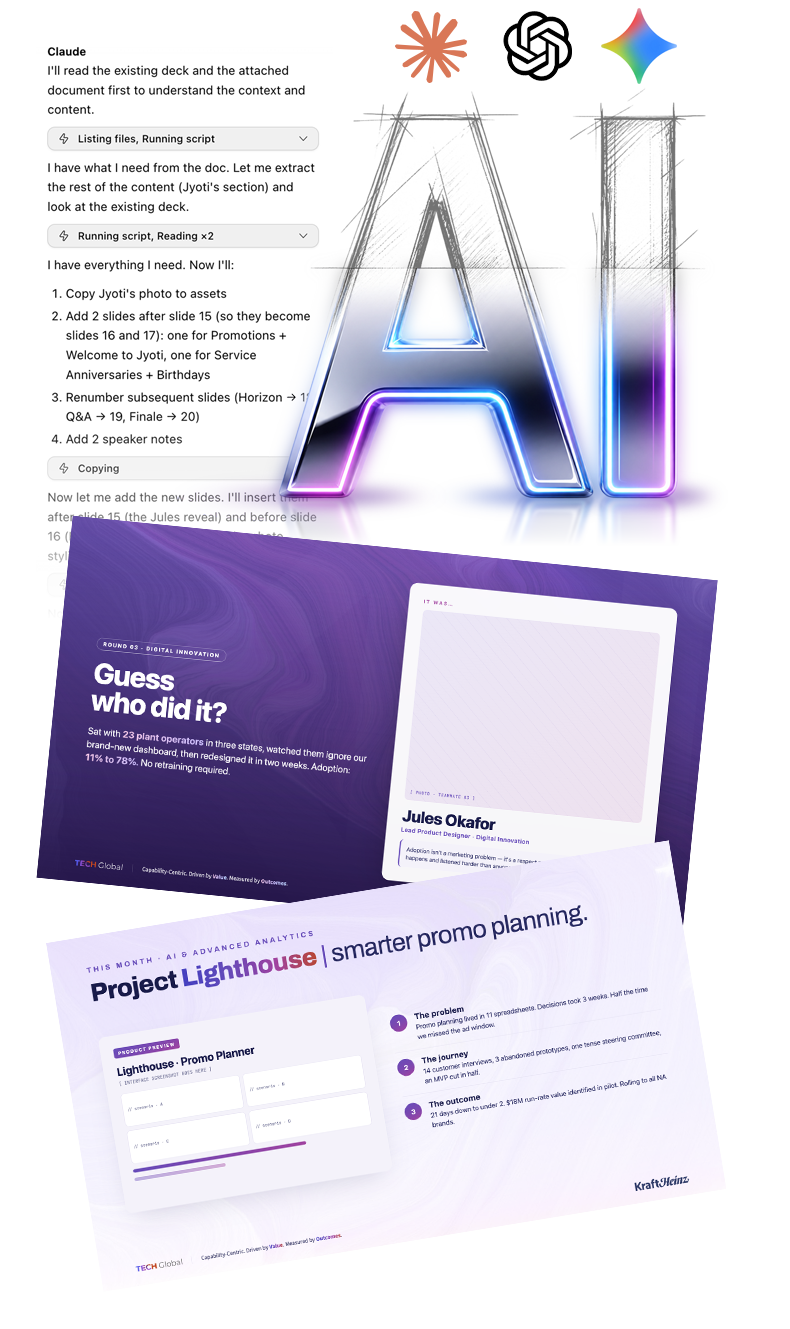
- Cross-platform tool fluency — building chatbot agents with OpenAI/ChatGPT, working through strategy and pitfalls with Google/Gemini, and producing prototypes and presentation decks with Anthropic/Claude.
- Personal workflow integration — using AI daily for image creation, discovery, prototyping, day planning, satisfaction-score tracking across product features, and surfacing time savings across my own work.
Underneath all of it: a working philosophy that the prompt is the brief, the model is the junior, and the creative director is still the person responsible for the final result.
Faster work, better-equipped teams, and original creative that doesn't read as AI slop.
The Corteva training program moved a global workforce from anxiety to capability — giving team members the fluency to use AI tools responsibly and the framework to understand where the risks live. The Kraft Heinz HR transformation work put AI directly into the hands of employees as a personal assistant, removing administrative drag and shifting time toward strategic work. The broader use-case work across recruiting, frontline interactions, and process automation is expanding the surface area where the company gets value from AI rather than just talking about it.
Personally, AI has compressed my own discovery, prototyping, and presentation cycles to the point that I now think in prompts often enough that it threatens to derail my spoken human interactions. That's the cost of fluency. The benefit is that I get to spend more of my time on the part of the work AI can't do — having the original vision in the first place.
That's the real outcome, and the one that matters most for the rest of my career: my decades of original creative work mean that when I direct an AI tool, the input is a point of view, not a recycled prompt scraped from someone else's reference. The output reflects that. It's the difference between elevated, polished creative that has a reason to exist and the generic AI slop that's flooding every channel right now. Garbage in, garbage out — and my skill set is what keeps the input from being garbage from the beginning.
The designers who treated AI as a threat are getting replaced by it. The ones who treated it as a tool — and brought original creative judgment to it — are running the rooms where it gets deployed. I intend to keep being in the second group.