Most designers today arrange components. Fewer and fewer can conceptualize the components.
The industry has standardized on layout tools — Figma, primarily — and an entire generation of product designers has come up without ever creating original visual elements from scratch. Brands ship work that looks indistinguishable from their competitors because the underlying craft of illustration, iconography, and a custom design language has thinned out. Generative AI has accelerated the trend, but it's also exposed the gap: the models can only remix what humans built first.
Across my career, I've been brought in by founding teams, Fortune 500 marketing orgs, and global enterprises specifically when a brand needed visual elements that couldn't be pulled from a stock library or a component kit — when the work needed to be the brand, not just use it.
Research the feeling, then design the artifacts that carry it.
Every engagement starts the same way: I study the brand and the audience to understand what the work needs to make people feel before they read a single word. Brands are usually defined by a small kit — a few colors, a couple of fonts, a photo treatment. My job is to expand that kit into a full visual vocabulary: the shape of a container, the iconography, the way an image breaks the visual plane, the rhythm of text across posters and signage. The goal is recognition without the logo.
That has meant different things on different projects:
- Founding-team identity work — drawing the IGN.com logo in 1997 as a founding member, when the rules for what online editorial brands looked like were still being written.
- Pixel-level OS craft — contributing to the realistic 3D desktop icons of a groundbreaking new operating system in 2001, where every shadow and bevel needed to read at 32 pixels.
- Photorealistic illustration for Fortune 500 marketing (2003–2008) — producing campaign-grade imagery that lifted brand and sales materials beyond what photography alone could deliver.
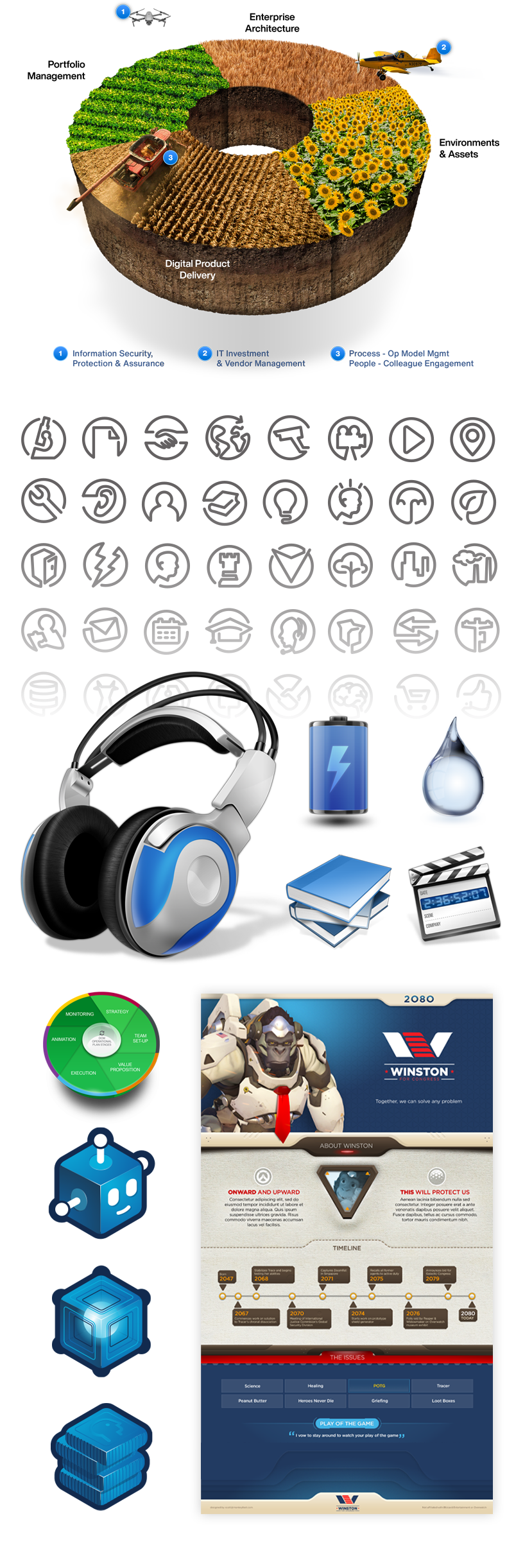
- Enterprise icon systems — 50+ brand icons for Schneider Electric covering services through installation; the initial app icon slate and guidelines for Corteva Agriscience at spin-off from Dow DuPont; an HR program icon suite for Kraft Heinz.
- Internal change-management creative — posters and launch campaign videos that helped large orgs land transformations their employees actually paid attention to.
Work that defined categories, moved revenue, and trained the next bench.
The brands speak for themselves. IGN became the dominant name in gaming media. The (redacted) OS icons shipped on tens of millions of desktops. The Schneider Electric and Corteva icon systems are still in use, still recognizable, still doing the work of the brand in places where the logo isn't.
The photorealistic illustrations between 2003 and 2008 helped Fortune 500 clients level up their marketing materials and measurably increase sales. The Corteva app icon system launched an identifyable app ecosystem as an independent company. The internal launch campaigns drove change-management adoption that would have stalled out on PowerPoint and emails alone.
The longest-running outcome is the bench. The team I built and mentored across my past roles now lead various creative teams at Ancestry, Apple, and Google — and the standards we set for creative are still the reference point those teams build from.
The through-line is simple: original work, made by hand, that brands and customers can recognize on sight. It's the kind of creative that generative tools still can't produce — because it's the kind of creative they had to be trained on.